




In a decision dated 9 February 20261, the European Union Intellectual Property Office (EUIPO) rejected an application filed by NIKE Innovate C.V. concerning a figurative sign placed in a specific position on the midsole of a sports shoe. The Office held that the sign, claimed as a position mark, was devoid of distinctive character within the meaning of Article 7(1)(b) of Regulation (EU) 2017/1001 on the European Union trade mark.
This refusal provides a clear illustration of the difficulties brand owners face when seeking trade mark protection for product design elements, particularly in industries characterised by extensive design freedom, such as the sports footwear sector.
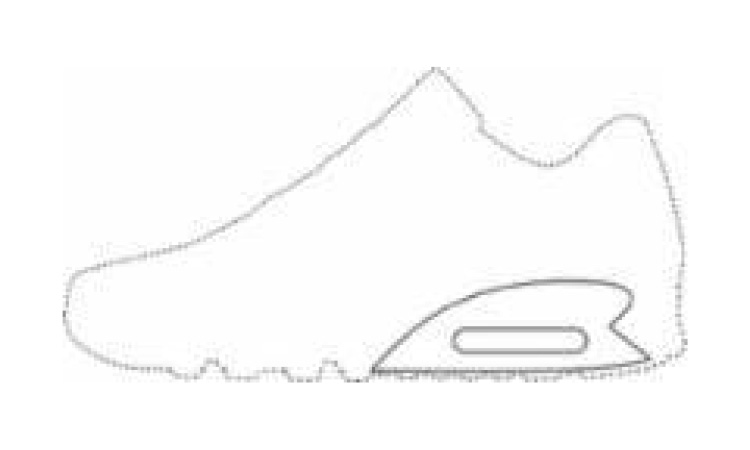
Nike sought registration of a figurative sign consisting of an elongated, curved and irregular shape applied to the rear part of the midsole of a shoe.
The application covered goods in:
Nike argued that this element was arbitrary, non-functional, visually striking, and capable of enabling consumers to identify the commercial origin of the goods.
The EUIPO recalls that, under Article 7(1)(b) EUTMR, signs which are devoid of distinctive character must be refused registration.
A mark is distinctive only if it enables the relevant public to identify the goods as originating from a particular undertaking and thus to distinguish them from those of other undertakings.
The Office refers to well-established case-law of the Court of Justice, including SAT.2, emphasising that the essential function of a trade mark is to guarantee origin and allow consumers to repeat or avoid purchasing experiences.
Distinctiveness must be assessed in relation to:
The EUIPO stresses that position marks are assessed in a manner comparable to figurative or three-dimensional marks, since they involve the application of elements to the surface of a product.
However, in sectors such as sports footwear, consumers are accustomed to a wide variety of midsole contours, cut-outs, reinforcements and decorative shapes.
In this context, only a sign that departs significantly from the norms or customs of the sector may be regarded as inherently distinctive.
In the present case, the Office found that the element claimed by Nike was merely an ordinary variation of midsole design, typical of aesthetic or structural features commonly encountered in the market.
Accordingly, the sign would be perceived as a decorative or functional design feature integrated into the shoe, rather than as an autonomous badge of origin.
Nike also relied on the existence of earlier registrations of similar marks in Class 25.
The EUIPO reiterates, however, that decisions on registrability must be assessed solely on the basis of the Regulation, and not by reference to previous Office practice. The EUIPO cannot register a non-distinctive sign simply because comparable marks may have been accepted in the past.
Nike further claimed that the sign had acquired distinctiveness through use under Article 7(3) EUTMR.
While the Office acknowledged Nike’s significant commercial and promotional efforts relating to the Air Max 90 model, it concluded that the evidence primarily demonstrated the reputation of Nike and the shoe as a whole, rather than consumer recognition of the specific midsole element as a trade mark in its own right.
The consumer surveys submitted, limited to a few Member States and based on relatively small samples, were held insufficient to establish recognition across the European Union, as required by the unitary nature of the EU trade mark.
Through this decision, the EUIPO confirms its consistent approach: obtaining trade mark protection for a design element as a position mark requires a clear demonstration that the sign is immediately perceived by consumers as an indicator of origin.
In sectors with high design freedom, such as footwear, midsole shapes and contours are generally viewed as aesthetic or functional product features, making inherent or acquired distinctiveness particularly difficult to establish.
This case therefore underlines the importance for companies to adopt a combined protection strategy (trade marks, designs, unfair competition) in order to secure long-term protection of product innovations.
1 EUIPO, Operations Department, Refusal of application No 019169533, NIKE Innovate C.V., Decision of 9 February 2026.


