




Can a slogan claiming the “freedom” of Mickey become a trademark for clothing?
In opposition proceedings B 3 229 556, the EUIPO rejected EU trademark application No. 19 069 735, consisting of the verbal sign “MICKEY IS FREE!”, covering clothing in Class 25, including t-shirts, sweatshirts, hoodies, jackets and long-sleeved shirts.
The opponent, Disney Enterprises, Inc., invoked its earlier EU trademark No. 18 790 923, composed of the term MICKEY, the word DISNEY, the formulation & CO., and a figurative representation of Mickey Mouse’s head. Disney argued that there was a likelihood of confusion, including a likelihood of association.
The applicant, conversely, claimed that the slogan was a form of independent artistic expression, allegedly referring to the (partial and territorially limited) entry of “Steamboat Willie” into the public domain in the United States. The applicant further argued that disclaimers such as “Don’t be confused! Nothing (…) to do with Disney Co.” would prevent any confusion. The EUIPO’s decision addresses, and rejects, each of these arguments.
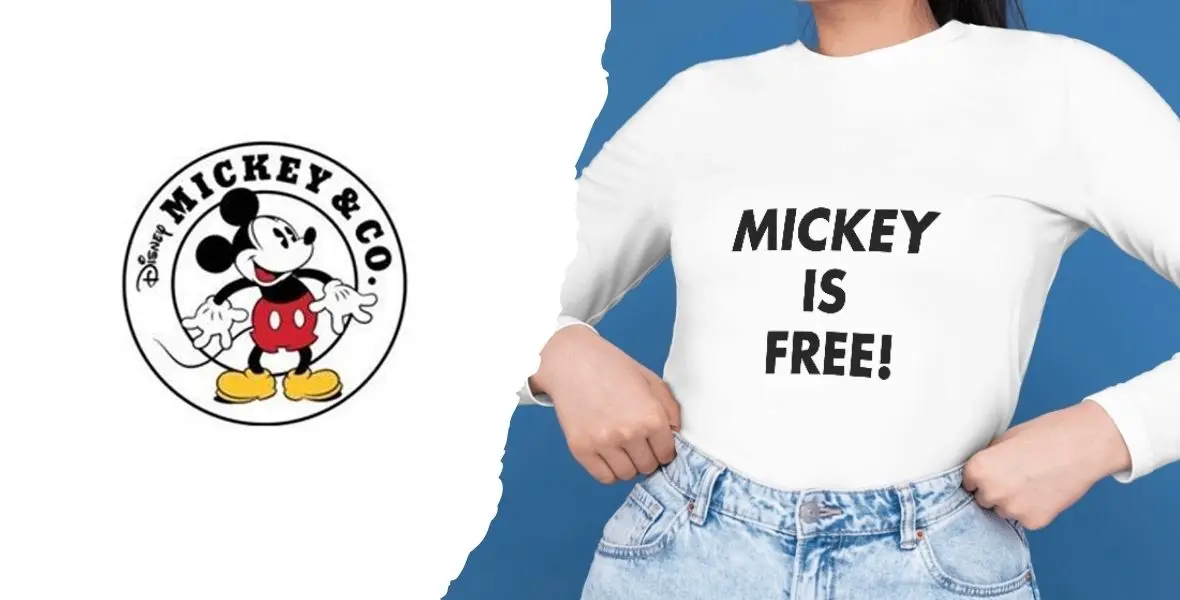
The Opposition Division first concluded that the goods were identical, either because they were literally identical in both specifications, or because they were included within broader terms already protected (for example, hoodies included within sweatshirts or long-sleeved shirts included within shirts).
The applicant argued that the products would be sold as “activist streetwear” to a targeted audience, and outside traditional commercial channels. The Office dismissed this argument, recalling that the assessment must be strictly based on the terms of the specification, independently of any claimed commercial strategy.
Similarly, commercial disclaimers are held to be legally irrelevant. In trademark law, the perception of the sign is assessed on its own, as it appears to consumers, and not based on additional statements displayed on a website, label or marketing campaign. The essential function of the trademark requires an ex ante assessment, centred solely on the sign.
The EUIPO considers that the verbal element MICKEY is the dominant element of both signs. In the clothing sector, this term is not descriptive, laudatory or evocative of product characteristics; it therefore enjoys a normal level of distinctiveness. The earlier mark also includes the immediately recognisable figurative representation of Mickey Mouse, reinforcing the link with the character, while the terms DISNEY and & CO. retain a secondary role.
In the contested sign, the wording “IS FREE!”, even emphasised by an exclamation point, does not alter the central consumer perception, which remains focused on the term MICKEY. The EUIPO stresses that the alleged reference to the “public domain” requires a specific legal and cultural understanding, highly unlikely in the case of average clothing consumers. This argument therefore does not create any conceptual distance capable of counteracting the dominance of MICKEY.
The comparison leads to:
To assess the likelihood of confusion, the EUIPO places its analysis within the specific context of the fashion market, characterised by the widespread use of brand variations, slogans, thematic collections, collaborations, limited editions and humorous capsules. Consumers, who display an average level of attention, are therefore familiar with the idea that a brand may extend its core identity into expressive, provocative or playful versions.
Against this backdrop, the slogan “MICKEY IS FREE!” is likely to be perceived as a thematic sub-collection originating from Disney, possibly aimed at younger consumers or at a “rebellious” capsule line. This perception is sufficient to establish a likelihood of association, which, under EU law, is by itself enough to characterise a likelihood of confusion.
Finally, the EUIPO underlines that it was not even necessary to assess whether the earlier mark had enhanced distinctiveness: a normal level of distinctiveness sufficed to reject the application.
This decision rightly clarifies that the public domain is not a free pass to appropriate a sign as a trademark, particularly when that sign capitalises on an existing distinctive character built by another party. The slogan “MICKEY IS FREE!” claims to challenge Disney’s monopoly, but in reality, it relies precisely on the attraction of that brand to produce a visual and commercial impact.
Artistic expression does not erase the trademark function, nor does it neutralise consumer perception of origin. Creative provocation may be stylistic; it is not a legal defence. Mickey may be “free” in theory, but certainly not as a trademark.


